
Polonnaruwa Vatadage
- Sri Lanka
Overview
Vatadage Polonnaruwa stands as one of Sri Lanka’s most fascinating ancient places.
Speaking of which, this circular relic holds the imagination of everyone who visits. And honestly, it’s not hard to see why.
Located within the ancient city of Polonnaruwa, the Vatadage represents a perfect combination of spiritual aspects and architectural designs.
Furthermore, it offers visitors a genuine glimpse into the island’s glorious past.
In fact, the structure has managed to survive centuries. And to this day, it continues to inspire among historians, archaeologists, and travellers alike.
So, if you are wondering what could be here and some essential points of this place. We wrote this guide to help you with that.
Highlights
History of Vatadage in Polonnaruwa
The story of Vatadage dates back to the reign of King Parakramabahu I in the 12th century. Although some evidence suggests that parts of it may be even older.
This was a remarkable era for Sri Lankan civilization, and the kingdom of Polonnaruwa was thriving in every sense.
Speaking of which, the Vatadage was specifically built to protect the Tooth Relic of Buddha. Which held religious and political importance for the kingdom.
For that reason, the structure wasn’t just a religious monument but also a symbol of royal power and devotion.
With that, during this period, Polonnaruwa served as the capital of Sri Lanka, and the city was experiencing unprecedented growth.
Whereas the rulers invested heavily in grand architectural projects. And the Vatadage became one of the main highlights of this idea.
Moreover, the construction showed the advanced engineering skills and artistic vision of ancient Sri Lankan craftsmen.
In detail, the circular design was carefully came out to provide maximum protection for the sacred relic while creating a space for worship and meditation.
Plus, the Vatadage witnessed numerous important ceremonies and royal events throughout its active years.
As a matter of fact, kings would come here to pay their respects, and the structure played a central role in religious festivals.
To be honest, it’s fascinating to think about all the history these stone pillars have witnessed.
Conversely, when the capital eventually went down due to invasion, the Vatadage fell into neglect along with other monuments in the ancient city.
Where it remained hidden under jungle growth for centuries until archaeologists rediscovered and restored it by bringing this architectural masterpiece back to light.
Architectural Features of Vatadage
The Vatadage showcases some of the finest examples of ancient Sri Lankan architecture.
The structure follows a circular pattern, which was quite unique for its time.
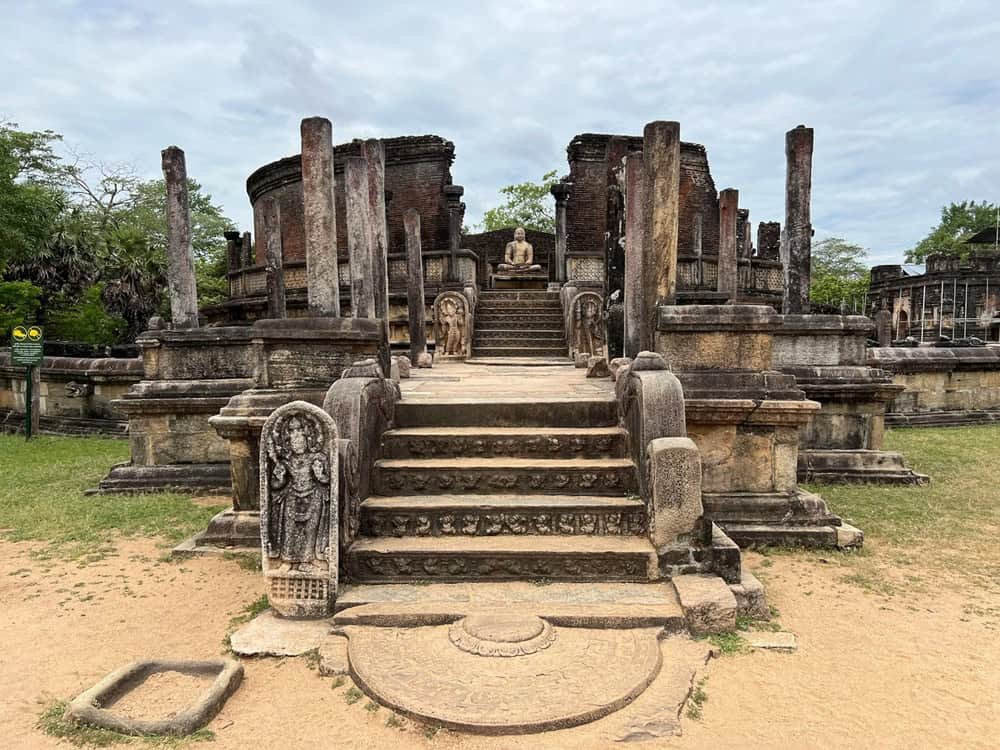
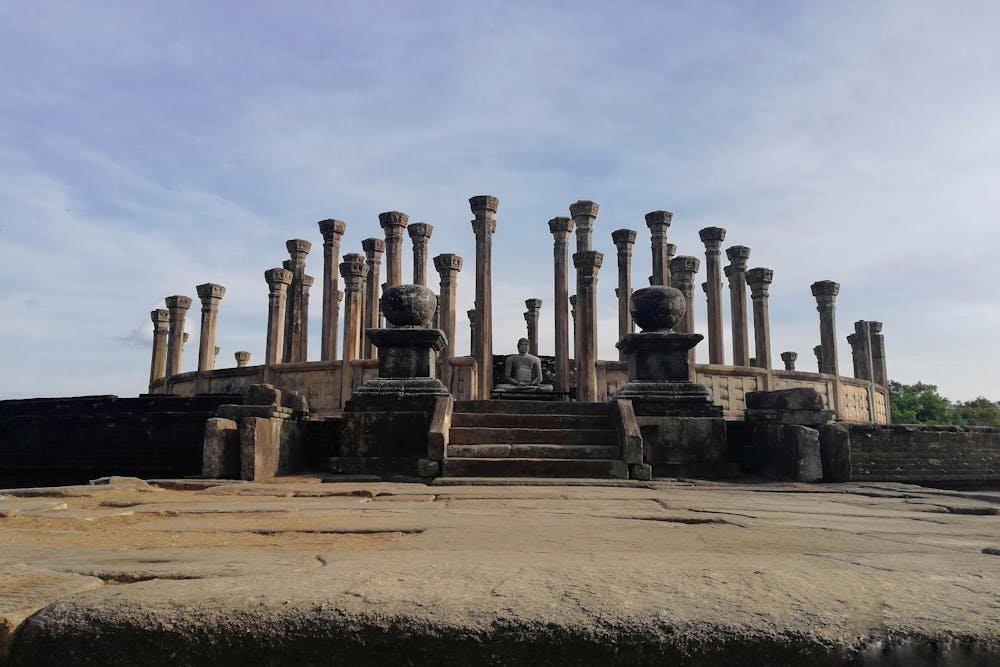
In detail, three concentric circular terraces rise gradually by creating a sense of importance toward the sacred centre.
Furthermore, this design wasn’t just about aesthetics; it also served practical purposes.
Whereas the terraces helped to protect the inner sanctum from the surrounding while allowing devotees to continue their worship in traditional Buddhist culture.
With that, in the centre area of Vatadage, you can find a small stupa, which once housed the sacred Tooth Relic.
This central stupa is surrounded by four Buddha statues, each facing one of the four (NEWS) directions.
These statues remain remarkably well-preserved, and their expressions continue to get visitors’ attention.
In fact, the craftsmanship is absolutely stunning, with each Buddha statue detail in the facial features, robes, and hand gestures.
Moreover, the positioning of these statues creates a powerful spiritual atmosphere within the space.
Moving on, the entrance to the Vatadage has a short, unique path with moonstone, which is considered one of the finest examples of this art form in Sri Lanka.
Note: Moonstones are semicircular stones that are placed at the bottom of staircases, and they hold deep symbolic meaning in Buddhist architecture.
To add to that, the Polonnaruwa moonstone shows various animals and floral patterns by representing the cycle of life and the path to enlightenment.
Trust us, the level of detail is extraordinary, especially considering the tools that were available to craftsmen in the 12th century.
Furthermore, the stone pillars that you can see there once supported a wooden roof that protected the entire structure.
Although the roof is no longer there, the pillars remain standing in their original positions for now.
Best Time to Visit
Timing your visit to Vatadage can obviously change your experience.
So here are some points to give you an idea:
Dry Season
The dry season, which runs from May to September, generally offers the most comfortable weather conditions for exploring the ancient city.
That is because the skies are clearer during these months, and rainfall is rare.
For that reason, many travellers prefer this period for their Polonnaruwa travels.
In fact, early morning visits come highly recommended for several practical reasons.
Whereas the site opens at sunrise, and visiting during the first few hours of the day means you’ll interact with fewer people.
Furthermore, the morning light creates beautiful photography opportunities, especially when it illuminates the Buddha statues and stone carvings.
On the other hand, late afternoon can also work well for visits, particularly if you want to experience the site in lighter sunlight.
Conversely, the middle of the day tends to be quite hot and crowded. Whereas the sun can be intense between 11 AM and 3 PM.
For this reason, we suggest avoiding peak afternoon hours whenever possible.
Monsoon Season
The monsoon season from October to January brings more unpredictable weather conditions.
While you might experience rain during this period, the surrounding area becomes greenery, which has its own appeal.
Moreover, tourist numbers tend to be lower during these months, so that you might enjoy a more peaceful experience.
However, be prepared with appropriate items like umbrellas and raincoats, as well as flexible scheduling, in case of sudden showers.
Public Holidays
Public holidays and weekends can be crowded, so be aware of this when planning your visit.
Furthermore, special Buddhist holidays may bring additional devotees to the site.
On the bright side, these occasions can actually offer unique cultural experiences, but they also mean more people and potentially longer waits.
Therefore, we’d recommend checking the calendar and deciding based on whether you prefer the relaxation or the energy of shared celebration.
Entrance Fees and Timings
Fee
To visit Vatadage, a ticket for the Polonnaruwa Archaeological Site is required, as the structure is part of this larger complex.
So, foreign visitors typically pay around $35 for entry, while children pay $18.
To be honest, the ticket might seem a bit pricey at first glance, but it grants access to numerous ancient monuments throughout Polonnaruwa, not just the Vatadage.
For that reason, this makes it quite a reasonable value when you consider everything included.
On the other hand, local Sri Lankan visitors do not pay a fee.
Furthermore, the ticket remains valid for the entire day by allowing you to explore the archaeological zone at your own pace.
Therefore, we’d recommend keeping your ticket safe throughout your visit, as staff members might check it at various points within the complex.
Time
As for the time, the site opens daily at 7:00 in the morning and closes at 5:00 PM, though these times can change depending on the season.
Speaking of which, the gates typically stop admitting new visitors about 30 minutes before closing time.
For that reason, we’d suggest arriving with enough time to explore the Vatadage and the surrounding monuments properly.
To give you an idea, spending at least two to three hours in the archaeological zone allows for a perfect experience without feeling in a hurry.
Plus, tickets can also be purchased at the main entrance to the Polonnaruwa Archaeological Museum, which is conveniently located near the ancient city.
Moreover, the staff at the ticket counter can provide basic maps and information about the site. Whereas hiring a local guide is possible at the entrance, though this comes at an additional cost.
Conversely, if you prefer self-guided exploration, informational signs are posted throughout the site.
That being said, photography is generally permitted throughout the site, and no additional fees apply for personal cameras.
To be honest, it is best to bring a camera because the Vatadage offers countless stunning photo opportunities.
Conclusion
Vatadage Polonnaruwa represents more than just an archaeological site.
It stands as proof of Sri Lanka’s history and the remarkable achievements of ancient civilization.
Furthermore, experiencing this ancient place in person creates wonderful memories and an appreciation for the island’s historical legacy.
Therefore, whether you’re a history lover or an architecture seeker, the Vatadage offers something truly special that resonates long after your visit ends.
Frequently Asked Questions
Q: What is Vatadage Polonnaruwa?
Vatadage Polonnaruwa is a circular relic house built in the 12th century to protect the sacred Tooth Relic of Buddha.
Q: Why is Vatadage important in Sri Lankan history?
The Vatadage held both religious and political importance as it housed the sacred Tooth Relic during Polonnaruwa’s time as the capital.
Q: What are the main architectural features of Vatadage?
The main features include three circular terraces, a central stupa, four Buddha statues facing cardinal directions, a fascinating moonstone at the entrance, decorative stone pillars, guard stones, and stone carvings throughout the structure.
Q: How can I reach Vatadage Polonnaruwa?
Vatadage is located within the Polonnaruwa Archaeological Site, which is accessible by road from major cities. In fact, visitors can hire taxis, take buses to Polonnaruwa town, or join organised tours.
Get a Quote!
Your Expert Partners in
Travel Planning
Planning a vacation should feel exciting—not overwhelming. That’s where we come in. With a deep understanding of destinations, logistics, and what makes a trip truly special, our team of travel professionals handles every detail for you.